Melbourne Annual Macro Policy Meeting
Thursday 30 & Friday 31 October, the University of Melbourne
The annual Melbourne Macro Policy Meeting gathers academics and researchers in policy institutions, and policy analysts to discuss the latest research and thinking about macroeconomic issues and policies. This event is co-hosted by the Department of Economics and the Melbourne Institute.
This year our theme is: "Macroeconomic policy and global uncertainty".
Details
- Two-day event, Thursday 30 - Friday 31 October 2025
- Held at the Melbourne Business School, 200 Leicester Street, Carlton 3053
Keynote Speakers
- Professor Giancarlo Corsetti
Pierre Werner Chair and Professor of Economics, European University Institute - Professor Eric Swanson
Professor of Economics, University of California, Irvine
Policy panel:
- Catherine de Fontenay, Commissioner, Productivity Commission (Panel Moderator)
- Giancarlo Corsetti, Pierre Werner Chair and Professor of Economics, European University Institute
- Prasanna Gai, The University of Auckland, and Monetary Policy Committee, Reserve Bank of New Zealand
- Warwick J. McKibbin, Director, Centre for Applied Macroeconomic Analysis, the Australian National University
- Eric Swanson, Professor of Economics, University of California, Irvine
Important dates
| Tuesday 1 July | Paper submissions open |
| Sunday 31 August | Paper submissions close |
| Monday 15 September | Notification of paper acceptance |
Monday 29 September | Registrations open |
Friday 24 October, 5pm | Registrations close |
Thursday 30 and Friday 31 October | Conference |
Organising committee
Guay Lim, Professorial Fellow, Melbourne Institute of Applied Economic and Social Research, the University of Melbourne
Mei Dong, Professor, Department of Economics, Faculty of Business and Economics, the University of Melbourne
Program committee
Sushant Acharya, Associate Professor, Department of Economics, Faculty of Business and Economics, the University of Melbourne
Mei Dong, Professor, Department of Economics, Faculty of Business and Economics, the University of Melbourne
Matthew Greenwood-Nimmo, Professor, Melbourne Institute of Applied Economic and Social Research, the University of Melbourne
James Hansen, Senior Lecturer, Department of Economics, Faculty of Business and Economics, the University of Melbourne
Tim Kam, Associate Professor, Research School of Economics, Australian National University
Guay Lim, Professorial Fellow, Melbourne Institute of Applied Economic and Social Research, the University of Melbourne
Benjamin Wong, Associate Professor, Econometrics & Business Statistics, Monash University
Sponsors
View the 2024 Macro Policy Meeting program
The Macro Policy Meeting will take place at the Melbourne Business School, 200 Leicester St, Carlton, the University of Melbourne.
Day 1 - Thursday 30 October
| Time | Session |
|---|---|
| 8:30am - 9:00am | Registration |
| 9:00am - 9:15am | Opening remarks - |
| 9:15am - 10:45am | Session 1: Monetary Policy Inflation Disagreement Weakens the Power of Monetary Policy Resolving New Keynesian Puzzles - (and presentation slides) Behavioural Expectations Under Indeterminacy: An Empirical Evaluation- (and presentation slides)
|
| 10:45am - 11:15am | Morning Tea |
| 11:15am - 12:45pm | Keynote Address The Short Lags of Monetary Policy |
| 12:45pm - 1:30pm | Lunch |
| 1:30pm - 3:00pm | Session 2: Empirical Macro Özer Karagedikli (Asia School of Business in collaboration with MIT Sloan) Kenneth Kuttner (Williams College) RBA’s Reaction Function as Perceived by Forecasters Jonathan Hambur (Reserve Bank of Australia) Qazi Haque (The University of Adelaide) An Alternative Approach to Estimate the Impact of the Fed’s Balance Sheet Policies Pratiti Chatterjee (The University of Western Australia) |
| 3:00pm - 3:30pm | Afternoon Tea |
| 3:30pm - 5:00pm | Session 3: Fiscal Policy Huixin Bi (Federal Reserve Bank of Kansas City) Maxime Phillot (Swiss National Bank) Sarah Zubairy (Texas A&M University)
|
| 5:30pm - 9:00pm | Dinner Note: only for attendees who registered |
Day 2 - Friday 31 October
| Time | Session |
|---|---|
| 8:45am - 9:15am | Registration |
| 9:15am - 10:45am | Session 4: International How Important Is Global R-star for Open Economies? - (and presentation slides) |
| 10:45am - 11:15am | Morning Tea |
| 11:15am - 12:45pm | Keynote Address |
| 12:45pm - 1:30pm | Lunch |
| 1:30pm - 3:00pm | Policy Panel Catherine de Fontenay, Commissioner, Productivity Commission (Panel Moderator) |
| 3:00pm - 3:30pm | Afternoon Tea |
| 3:30pm - 5:00pm | Session 5: Australian Macro The Mortgage Debt Channel of Monetary Policy When Mortgages are Liquid Monetary Policy and the Homeownership Rate |
| 5:00pm - 5:15pm | Closing remarks - Professor Phillip McCalman, Head of Department, Department of Economics, the University of Melbourne |
The 2025 Melbourne Annual Macro Policy Meeting will take place at Melbourne Business School, located on The University of Melbourne's Parkville campus - 200 Leicester Street, Carlton, 3053.
Getting to the University
From the CBD:
To get to The University of Melbourne from Melbourne's city center, simply catch any tram going up Swanston Street. These trams run from Flinders Street Station and allow you to disembark at Stop 1 – opposite the University.
The Veriu Queen Victoria Market Hotel is a ten-minute walk to the University and located in the vibrant area of the Queen Victoria Market.
From Carlton:
Zagame's House, Best Western Plus Travel Inn, and Melbourne Carlton Central Apartment Hotel are a 12–15 minute walk from the University of Melbourne.
Navigating The University of Melbourne
The University of Melbourne was founded in 1853 and is Australia’s second oldest university. The University spans two campuses with main campus located in Parkville and the second campus located in Southbank, where the Victorian College of the Arts resides.
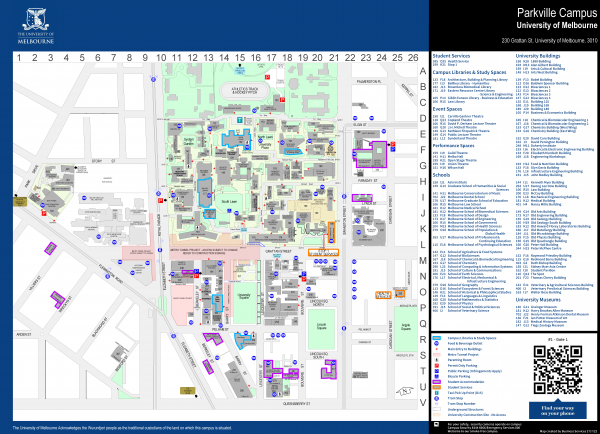
You can view map of the Parkville Campus below, download a PDF copy, or access The University of Melbourne interactive map.
Navigating Melbourne
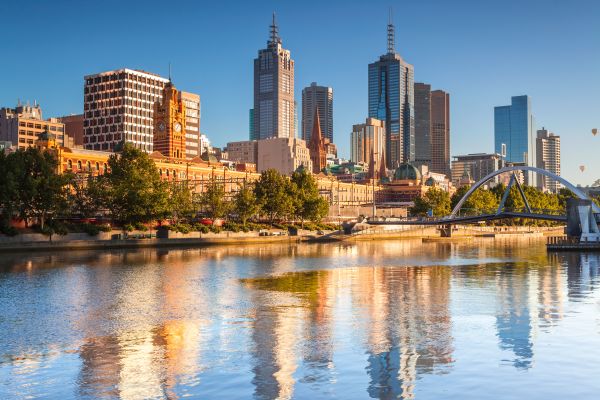
Melbourne, the capital of Victoria, is a beautiful city with fine buildings and spacious parks, which gives Melbourne its 'garden-city' title. Settlers from a variety of countries have given Melbourne a cosmopolitan outlook and the city has developed as the cultural, fashion, shopping, sporting and culinary centre of Australia.
Catching public transport:
Using public transport in the Melbourne CBD requires a myki card. You can purchase a myki card at most convenience stores or major train stations across Melbourne for $6. This will provide you access to Melbourne's trams, trains, and buses. There is a ‘Free Tram Zone’ within the Melbourne CBD, however outside of this area you will need to 'Touch On' your myki. You can download a map of the Free Tram Zone here. The free PTV app is also a useful resource to help with navigation by public transport.
Travelling from the airport:
The SkyBus travels from Tullamarine Airport to Southern Cross Station in the Melbourne CBD. The shuttle bus leaves the airport roughly every 20 minutes and costs $24 for a one-way pass or $40 for a return fare. Private shuttle buses from the airport can also be booked.
Things to see and do in Melbourne:
The central business district of Melbourne is based around the delta of the Yarra River at the top of a large bay. The city area contains some of Australia's finest parks, gardens and historic buildings, all within walking distance. Melbourne is also Australia's entertainment, sporting and cultural capital. Nearly every cuisine is represented in Melbourne's hundreds of restaurants and cafes.
Places of interest include:
- Melbourne Zoo
- Melbourne Skydeck for the awe inspiring view of Melbourne from the Southern Hemisphere's highest viewing platform
- Fed Square, a venue for food, arts, culture and public events across from Flinders St Station, including the amazing Torres Strait owned and operated Indigenous restaurant, Mabu Mabu
- Many waterfront restaurants and cafes along the Yarra River or the District Docklands precinct
- The National Gallery of Victoria
- Royal Botanic Gardens, recognised as one of the world's best, extending over 38 hectares and housing a collection of more than 8,500 species of plants from around the world
- The Koorie Heritage Centre, exploring 60,000 years of culture of the Indigenous people of south-eastern Australia
For more information on Melbourne and its surrounding regions, please visit the following websites:
For queries contact:
Email: melb-macro-policy@unimelb.edu.au