Health Analytics, Leadership, and Economics (HALE) Hub
Transforming Australian Healthcare:
Data-Driven Insights for a Healthier Future
Health Analytics, Leadership, and Economics (HALE) Hub
The Health Analytics, Leadership, and Economics (HALE) Hub aims to revolutionise healthcare by addressing the global challenge of escalating costs and championing the importance of an efficient and equitable healthcare system.
In a landscape where healthcare funding often hinges on service volume rather than health outcomes, the HALE Hub's mission is to provide robust evidence that drives effective policy development. Through rigorous causal analyses of key policy reforms and the integration of cutting-edge AI methodologies, the HALE Hub aims to provide policymakers with insights that pave the way for transformative changes and create new technologies which empower patients to make their own decisions on their health and healthcare.
The HALE Hub, named after the concept of being healthy and free from disease, goes beyond academia to have a broader impact on society. Its mission is to influence policies that affect individuals and communities, with the ultimate goal of creating a healthier and more equitable future.






Prof Erin Strumpf

Ms Bernice Ma



Ms Martina Repetto


Dr Portia Cornell

Ms Lauren Cordwell
Current
2024: NSW Independent Pricing and Regulatory Tribunal. IPART Out-of-Home Care Review: Cost of Caring.
Researchers: Ou Yang, Ron Fisher, Karinna Saxby, Jongsay Yong, Yuting Zhang.
2024-2027: Faculty of Business and Economics, the University of Melbourne. Transforming Australian healthcare: Data-driven insights for a healthier future.
Researchers: Yuting Zhang, Jongsay Yong, Charles Kemp, Nathan Kettlewell, Eric Sun, Inma Hernandez, Mike Stephens.
2021-2025: Australian Research Council Future Fellowship. Studying Medicare and private health insurance design to improve policy developments, and inform value-based healthcare, and empower patients to participate in their own healthcare.
Researcher: Yuting Zhang.
2021-2023: Medibank Health Research Fund. The impact of price transparency on price variation and out of pocket costs.
Researchers: Adam Elshaug, Khic Prang, Anthony Scott, Jongsay Yong, Susan Méndez.
2020-2024: NHMRC MRFF Targeted health system and community organization research. Predicting the population health economic impact of current and new Cancer Treatments (PRIMCAT).
Researchers: Maarten IJzerman, Yuting Zhang, Peter Gibbs, Sallie-Anne Pearson, Koren Degeling, Fanny Franchini, Ben Solomon, Grant McArthur, Stephen Fox, Jeyesh Desai.
2018-present: UNSW and Monash University. Economic evaluation of cytisine vs varenicline on smoking cessation: A randomized clinical trial.
Researchers: Karinna Saxby, Dennis Petrie, Andrew Ireland, Rohan Sweeney, Ryan J Courtney, Hayden McRobbie, Michael Farrell.
2018-present: Royal Women’s Hospital/Royal Melbourne Hospital and Breast Cancer Trials Research. Economic evaluation of a clinical trial of omitting radiotherapy among women with early-stage invasive breast cancer.
Researchers: Karinna Saxby, Gregory Bruce Mann, Allan Park, Dennis Petrie.
Past
2021-2022: WISE Employment Services. The impact of employment on mental healthcare use among people with disability: Distinguishing between part-and full-time employment.
Researchers: Karinna Saxby, Helen Dickinson, Dennis Petrie, Anne Kavanagh, Zoe Aitken.
2022: Victorian Department of Health. Enhancing the Department’s multivariant demand driver model to accommodate and evaluate the impact of COVID-19 on service costs.
Researchers: Jongsay Yong, Ou Yang, Yuting Zhang.
2022: Independent Health and Aged Care Pricing Authority. Assisting in the Pricing Authority’s development of methodology to evaluate the impact of COVID-19 on hospital cost and activity.
Researchers: Jongsay Yong.
2021: Department of Treasury and Finance, Victoria. Developing an assessment framework to assess and review COVID-19 policy responses in relation to the GST distribution across Australian States.
Researchers: Jongsay Yong, Susan Mendez.
2020-2021: Department of Veterans’ Affairs (DVA). Examining impact of military service on Veterans’ wellbeing and aging using large existing data including Australian taxation record, Medicare data, DVA healthcare data, and HILDA data.
Researchers: Judith Liu, Yuting Zhang.
2020-2021: Victorian Department of Health and Human Services. Re-designing stroke care pathways under a value-based healthcare approach.
Researchers: Yuting Zhang, Danielle Romanes.
2019-2021: Department of Health and Aged Care. Mental health modelling and COVID-19 mental health response.
Researchers: Karinna Saxby, Dennis Petrie, Johannes Kunz, Sonja de New, Nicole Black, Anthony Harris, Daniel Avdic, Chris Schilling, James Taylor.
2020: Royal Commission into Aged Care Quality and Safety. Developing econometric models and applying the models to assess the effects of competition on prices and quality of residential aged care in Australia.
Researchers: Jongsay Yong, Ou Yang, Yuting Zhang, Anthony Scott.
2020: Australian Institute of Health and Welfare. Developing health system performance measures used by Australia.
Researchers: Anthony Scott, Yuting Zhang, Judith Liu.
2018-2020: Cancer Council NSW. Economic evaluation of the BreastScreen program. Developing the costing model and performing the economic evaluation under current and alternative screening strategies.
Researchers: Karinna Saxby, Gregory Bruce Mann, Allan Park, Dennis Petrie, Carolyn Nickson, Louiza Velentzis, Sabine Deij, Pietro Procopio.
2017-2020: US National Institutes of Health. Impact of insurance benefit design on patient outcomes: Evidence from the Medicare Part D coverage gap closure.
Researchers: Cameron Kaplan, Yuting Zhang.
2017-2020: Alzheimer's Association Research Grant to Promote Diversity. Claims data mining to predict side effects of anti-dementia drugs
Researchers: Inma Hernadez, Yuting Zhang.
Selected past projects
2018: Healthcare professional, Peak Body. Project lead for a team engaged to develop a HTA framework for a National peak body. This framework will assist the organisation in progressing policy changes through advocacy with the Australian Government.
Researcher: Karinna Saxby, Renae Beardmore.
2018: Department of Health and Aged Care. Improving the distribution of doctors through the new Rural Primary Care Stream.
Researchers: Susan Méndez, Anthony Scott.
2017-2018: Victorian Department of Health and Human Services. Analysing the relationship between health and socioeconomic status to inform development of loadings and risk-adjustment approaches for current and future funding models.
Researcher: Jongsay Yong, Ou Yang.
2015-2018: Commonwealth Fund in the US. Evaluating the effects of Pioneer ACOs on Medicare Part D spending.
Researcher: Yuting Zhang.
2017: Capital Health Network. Part of a team engaged to develop a model of care for Heart Failure patients in the Australian Capital Territory. Karinna Saxby assisted with stakeholder management, workshop coordination, project support and report development for the project.
Researcher: Karinna Saxby, Renae Beardmore.
2017: The World Bank. A theoretical model of physician dual practice and implications for empirical work
Researchers: Susan Méndez, Anthony Scott.
2016-2017: Victorian Department of Health and Human Services. Evaluating the statistical models and results from the out-of-home care reform – Residential care beds and targeted care program.
Researcher: Ou Yang.
2016-2017: Victorian Department of Health and Human Services. Evaluating the statistical models and results the Roadmap for Reform: Strong Families, Safe Children program.
Researcher: Ou Yang.
2013-2017: National Institutes of Health in the US. Optimizing Medicare Part D plan choice by beneficiaries with schizophrenia.
Researcher: Yuting Zhang, Judith Lave, Joe Newhouse.
2016: Commonwealth Fund. Updating measures of geographic variation in the quality of prescribing in Medicare.
Researcher: Yuting Zhang.
Australian Healthcare Atlas
The following maps present information on specialist fees, GP visits and psychiatrist services across different Statistical Area Level 3 (SA3) regions, based on the latest available data from the Person Level Integrated Data Asset (PLIDA).
Check costs and waiting times in your local area by zooming in to where you live on the map.
Policymakers can use this data to identify disparities in healthcare access and affordability. Regions with higher average fees or longer waiting times may indicate a lack of specialists, suggesting a need for policy interventions to attract more healthcare providers to these areas. The data can also guide resource allocation decisions. For instance, regions with longer waiting times might benefit from additional funding to increase service capacity. In addition, the data can help establish performance benchmarks for healthcare providers, encouraging improvements in service delivery and efficiency.
Patients can use the average fee information to anticipate potential healthcare costs and make informed decisions about which specialists to see based on their budget. Patients might prefer specialists with shorter waiting times, especially if their condition is urgent. This data can help them find providers who can see them sooner. If a patient is flexible about travel, they might choose to see a healthcare provider in a region with lower average fees or shorter waiting times.
Specialist Fees in FY 2024-2025
The findings presented are based on an analysis of Medicare claims data for the entire population using PLIDA data, aggregated at the Statistical Area Level 3 (SA3).
Select a speciality from the dropdown list -
Specialist Fees in 2023
The findings presented are based on an analysis of Medicare claims data for the entire population using PLIDA data, aggregated at the Statistical Area Level 3 (SA3).
Select a speciality from the dropdown list -
Psychiatric Specialists in 2023
These results are derived at the SA3-level from the universe of Medicare claims for adults (16 and above) within PLIDA. Psychiatric specialist in-person consultations are identified by MBS item codes 296, 299, 300, 302, 304, 306, and 308 in 2023.
Select a topic from the dropdown list -
General Practitioner (GP) in 2021
These results are derived at the SA3-level from the universe of Medicare claims for adults (16 and above) within PLIDA. GP services are defined based on the Broad Type of Service (BTOS) Category 101 in 2021.
Select a topic from the dropdown list -
General Methodology
All monetary values have been adjusted to reflect the 2023 Australian dollar value, using the Australian Consumer Price Index. We exclude all SA3 regions with an effective design population of zero (e.g., large National Parks), non-spatial regions (e.g., migratory, offshore), and, in accordance with data usage agreements, all regions which had less than ten specialists, GP, and psychiatrist services. These maps will be periodically updated to capture contemporary data. Additional details are available in Zhang (2024). Findings based on the use of Australian Bureau of Statistics 2023, Person-Level Integrated Data Asset (PLIDA),
Project credits
Funding for this work is from Australian Research Council Australian Future Fellowship award funded by the Australian Government (project ID FT200100630), and the University of Melbourne Faculty of Business & Economics HALE Hub funding.
Suggested citation
Liang, C., Saxby, K., Yang, O., & Zhang, Y., (2025) HALE Hub Data: Australian Healthcare Atlas, Melbourne Institute of Applied Economic and Social Research, The University of Melbourne.
https://melbourneinstitute.unimelb.edu.au/research/HALE-Hub/data
Global Leadership Program in Health Systems

In December 2025, the HALE Hub successfully delivered the 2025 Global Leadership Program in Health Systems and Analytics.
Medicare at 40
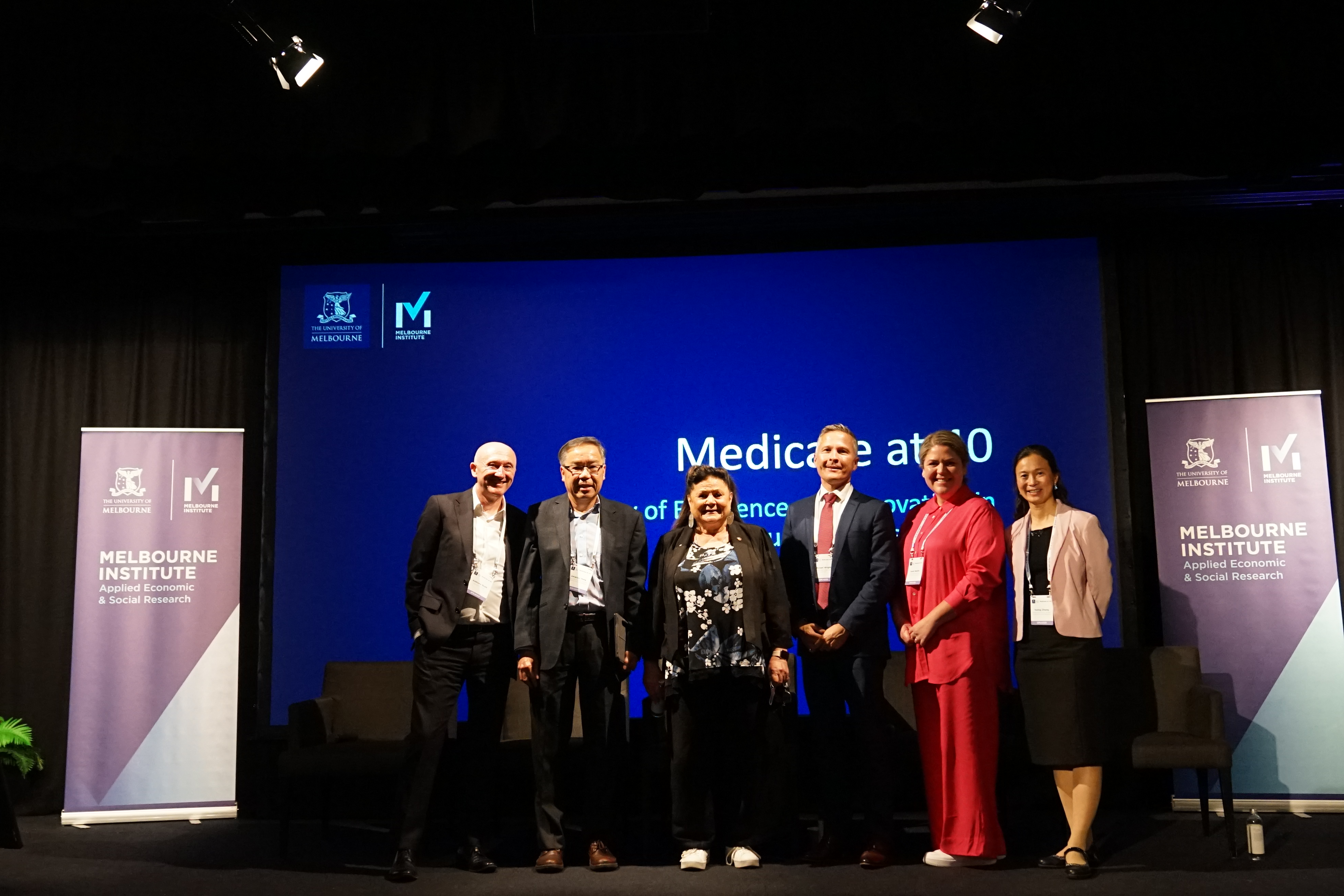
In 2024, we brought together policymakers, academics, and industry leaders together at the Melbourne Museum to celebrate the history and accomplishments of Medicare.