CALIBER Summit for AI-powered Research in Business & Economics
Tuesday 24 & Wednesday 25 November, the University of Melbourne
Held across two days, Tuesday 24 and Wednesday 25 November, the Collaborative AI Lab in Business & Economic Research (CALIBER) Summit for AI-powered Research in Business & Economics, will bring together researchers, industry partners, government organisations, and technology leaders to explore how artificial intelligence is reshaping research, decision-making, and innovation across business and economics.
The Summit will showcase leading applied and methodological work in AI-powered research, while facilitating knowledge exchange between academics, practitioners, and decision makers. It aims to foster lasting networks, spark new collaborations, and support the responsible development of AI tools, infrastructure, and research practices for business, economics, policy, and society.
Stay in the loop! Join the CALIBER AI Summit mailing list to stay up to date with future events, news, and opportunities.
Contact: Please send any questions to CALIBER-AI@unimelb.edu.au
Important dates
Tuesday 2 June | Paper submissions open |
Friday 21 August | Paper submissions close |
Monday 7 September | Notification of paper acceptance |
Monday 19 October | Registrations open |
Tuesday 17 November | Registrations close |
Tuesday 24 and Wednesday 25 November | Summit |
Organising committee
Jan Kabátek, Associate Professor, Melbourne Institute of Applied Economic and Social Research, the University of Melbourne
Maxim Ananyev, Senior Research Fellow, Melbourne Institute of Applied Economic and Social Research, the University of Melbourne
Taylor Ey, Research Fellow, Melbourne Institute of Applied Economic and Social Research, the University of Melbourne
Ujjwal KC, Research Fellow, Melbourne Institute of Applied Economic and Social Research, the University of Melbourne
About the Melbourne Institute
The Melbourne Institute is Australia’s pre-eminent economic and social policy research institution. We are renowned for our high-quality, independent and impartial applied research and our development of longitudinal survey tools. Our work with government, business and community groups has been powering effective change for over 60 years, and through our research we play an important role in creating fundamental policy and practice.
We enhance understanding of issues affecting Australia and Australians today, and apply this knowledge to shape debate and drive evidence-based change.
The CALIBER Summit for AI-powered Research in Business & Economics will take place at the Woodward Conference Centre, 185 Pelham St, the University of Melbourne.
Day 1 - Tuesday 24 November
| Time | Session |
|---|---|
| 8:15am - 9:00am | Registration |
| 9:10am - 9:20am | Conference welcome |
| 9:20am - 9:30am | Opening remarks |
| 9:30am - 10:30am | Keynote address From Data to Discovery: Developing AI Tools for Economic and Social Policy |
| 10:30am - 11:00am | Morning tea |
| 11:00am - 12:40pm | Session 1: AI Adoption, Work, and Society AI adoption and subscription dynamics in Australian transaction data Managers as gatekeepers in the age of AI GenAI and job quality in Australia’s ageing and gender-segregated workforce Human–AI collaboration in finance education: Developing and evaluating AI-assisted interactive finance simulators |
| 12:40pm - 1:40pm | Lunch |
| 1:40pm - 3:20pm | Session 2: Building AI-Enabled Research and Learning Infrastructure Chair: Ujjwal KC (Melbourne Institute) Ask ABARES: Building an agentic retrieval-augmented generation system for a government economic research agency Machine-readable economics papers for agentic research Safeguarding knowledge: A systematic review of AI-content detection tools, algorithms, and institutional challenges. Comparison as Insight: Iteratively Designing a Human-AI Collaborative Agent for Public Opinion Research |
| 3:20pm - 3:50pm | Afternoon tea |
| 3:50pm - 5:00pm | Panel session |
Day 2 - Wednesday 25 November
| Time | Session |
|---|---|
| 8:15am - 9:00am | Registration |
| 9:00am - 9:10am | Opening comments |
| 9:10am - 10:10am | Keynote address |
| 10:10am - 10:40am | Morning tea |
| 10:40am - 12:20pm | Session 3: AI for Text, Classification, and Evidence Synthesis Chair: Taylor Ey (Melbourne Institute) Interpretable textual classifiers for complex economic questions Evaluation of AI-based coding of occupation responses in the HILDA Survey Using AI to combine qualitative and quantitative economic data: Application to life-history data of urban job-seekers |
| 12:20pm - 1:20pm | Lunch |
| 1:20pm - 3:00pm | Session 4: AI for Financial, Strategic, and Trusted Decision-Making Chair: Filippo Dell'Andrea (The University of Melbourne) Pivotal: A new language for interactive data workflows Imag(in)ing the bull and bear markets Climate risk through the eyes of insurers: Earnings calls and the cross-section of stock returns AI-assisted strategic decision-making for vehicle-to-grid energy management: A constraint-aware deep reinforcement learning and stackelberg framework |
| 3:00pm - 3:30pm | Afternoon tea |
| 3:30pm - 4:45pm | Panel session |
| 4:45pm - 4:50pm | Dean's closing address Professor Serge da Motta Veiga, Dean and Sidney Myer Chair of Commerce, Faculty of Business and Economics, The University of Melbourne |
| 4:50pm - 5:00pm | Reflections and takeaways Jan Kabátek, Melbourne Institute |
Getting to the University:
The CALIBER AI Summit will take place at the Woodward Conference Centre, Level 10, 185 Pelham St, Carlton, at The University of Melbourne's Parkville campus.
Accessible Wayfinding document download (DOCX 38.2 KB)
From the CBD:
To get to the University of Melbourne from the Melbourne city centre, simply catch any tram going up Swanston Street. These trams run from Flinders Street Station and allow you to disembark at Stop 1 – opposite the University.
The Veriu Queen Victoria Market Hotel is a ten-minute walk to the University and located in the vibrant area of the Queen Victoria Market.
The Crown Plaza Melbourne Carlton is also a short walk to the University, located on Swanston St.
A third nearby option is the Lyf on Elizabeth Melbourne in the CBD.
From Carlton:
Zagame's House, Best Western Plus Travel Inn, and Melbourne Carlton Central Apartment Hotel are a 12–15 minute walk from the University of Melbourne.
Navigating The University of Melbourne
The University of Melbourne was founded in 1853 and is Australia’s second oldest university. The University spans two campuses with main campus located in Parkville and the second campus located in Southbank, where the Victorian College of the Arts resides.
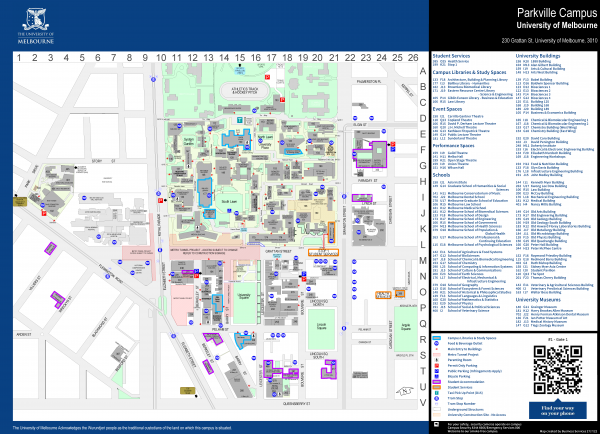
You can view map of the Parkville Campus below, download a PDF copy, or access The University of Melbourne interactive map.
Navigating Melbourne
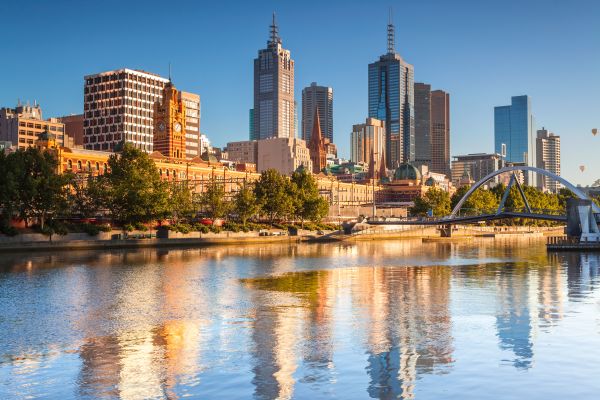
Melbourne, the capital of Victoria, is a beautiful city with fine buildings and spacious parks, which gives Melbourne its 'garden-city' title. Settlers from a variety of countries have given Melbourne a cosmopolitan outlook and the city has developed as the cultural, fashion, shopping, sporting and culinary centre of Australia.
Catching public transport:
Public transport commuters travelling on a full fare ticket are now able to use a credit card, phone or smartwatch across Melbourne.
Concession passengers will still need a myki card. You can purchase a myki card at most convenience stores or major train stations across Melbourne for $6.
There is a ‘Free Tram Zone’ within the Melbourne CBD, however outside of this area you will need to 'Touch On' your device, card or myki. You can download a map of the Free Tram Zone here. The free PTV app is also a useful resource to help with navigation by public transport.
Travelling from the airport:
The SkyBus travels from Tullamarine Airport to Southern Cross Station in the Melbourne CBD. The shuttle bus leaves the airport roughly every 20 minutes and costs $25.90 for a one-way pass or $43.40 for a return fare. Private shuttle buses from the airport can also be booked.
Things to see and do in Melbourne:
The central business district of Melbourne is based around the delta of the Yarra River at the top of a large bay. The city area contains some of Australia's finest parks, gardens and historic buildings, all within walking distance. Melbourne is also Australia's entertainment, sporting and cultural capital. Nearly every cuisine is represented in Melbourne's hundreds of restaurants and cafes.
Places of interest include:
- Melbourne Zoo
- Melbourne Skydeck for the awe inspiring view of Melbourne from the Southern Hemisphere's highest viewing platform
- Fed Square, a venue for food, arts, culture and public events across from Flinders St Station, including the amazing Torres Strait owned and operated Indigenous restaurant, Mabu Mabu
- Many waterfront restaurants and cafes along the Yarra River or the District Docklands precinct
- The National Gallery of Victoria
- Royal Botanic Gardens, recognised as one of the world's best, extending over 38 hectares and housing a collection of more than 8,500 species of plants from around the world
- The Koorie Heritage Centre, exploring 60,000 years of culture of the Indigenous people of south-eastern Australia
For more information on Melbourne and its surrounding regions, please visit the following websites:
For queries contact:
Website: Collaborative AI Lab in Business & Economic Research (CALIBER)
Email: CALIBER-AI@unimelb.edu.au