Australian Longitudinal Survey Methods Workshop
Thursday 25 & Friday 26 February, the University of Melbourne
Held across two days, Thursday 25 and Friday 26 February 2027, the inaugural Australian Longitudinal Survey Methods Workshop brings together researchers and practitioners to advance methodological research on the design and implementation of longitudinal surveys. The workshop provides a forum to share ideas, explore methodological challenges, and build collaborations within the longitudinal survey research community.
The workshop has an informal, discussion-focused format designed to encourage interaction and the exchange of ideas. Presentations are limited to 15 minutes and are followed by 15 minutes of discussion, allowing ample opportunity for participants to engage with presenters and one another.
Contact: Please send any questions to ALSM-Workshop@unimelb.edu.au
Important dates
Tuesday 4 August | Paper submissions open |
Friday 30 October | Paper submissions close |
Friday 20 November | Notification of paper acceptance |
Monday 8 December | Registrations open |
Thursday 18 February | Registrations close |
Thursday 25 and Friday 26 February | Workshop |
Organising committee
Nicole Watson, Co-Director, HILDA Survey Project, Melbourne Institute of Applied Economic and Social Research, University of Melbourne
Susan Morton, Director, Institute for Innovative Solutions for Well-being and Health (INSIGHT), University of Technology Sydney
Submissions to present at the Australian Longitudinal Survey Methods Workshop are now open.
We invite abstracts on methodological issues that are unique to, or of particular importance in, longitudinal surveys, including (but not limited to):
- Sampling issues, including refreshment sampling
- Mixed-mode data collection: effects on cost, measurement error, and attrition
- The role of interviewers in longitudinal surveys
- Data linkage and consent
- The use of biomarkers, apps, sensors and other innovative measurement instruments
- The use of AI (e.g. LLMs and machine learning) in survey processes
- Attrition and non-response: bias assessment, minimisation strategies, and adjustment methods (including weighting and imputation)
- Measurement error, including panel conditioning and recall error
- Other innovations in longitudinal survey methods
Submissions may present new methodological research, describe planned work to seek feedback, or review research and practice in a specific methodological area. The workshop emphasises work that stimulates discussion and collaboration, rather than polished conference-ready papers.
Submission requirements:
- Abstract (Microsoft Word or PDF format), up to 300 words
- Include the full name, position, and affiliations of all authors
- Submit to ALSM-workshop@unimelb.edu.au
Please share this with any colleagues or people within your network, especially new and junior staff, and PhD students, who may be interested in presenting.
Submissions deadline: Friday 30 October
All papers will be peer reviewed and submitting authors will be notified of outcomes by Friday 20 November.
Session format: Three papers will be presented in each session. Each presentation should be 15 minutes, followed by 15 minutes for discussion.
If you have any enquiries, please contact ALSM-workshop@unimelb.edu.au.
Getting to the University:
The Australian Longitudinal Survey Methods Workshop will take place at The University of Melbourne's Parkville campus.
From the CBD:
To get to the University of Melbourne from the Melbourne city centre, simply catch any tram going up Swanston Street. These trams run from Flinders Street Station and allow you to disembark at Stop 1 – opposite the University.
The Veriu Queen Victoria Market Hotel is a ten-minute walk to the University and located in the vibrant area of the Queen Victoria Market.
The Crown Plaza Melbourne Carlton is also a short walk to the University, located on Swanston St.
From Carlton:
Zagame's House, Best Western Plus Travel Inn, and Melbourne Carlton Central Apartment Hotel are a 12–15 minute walk from the University of Melbourne.
Navigating The University of Melbourne
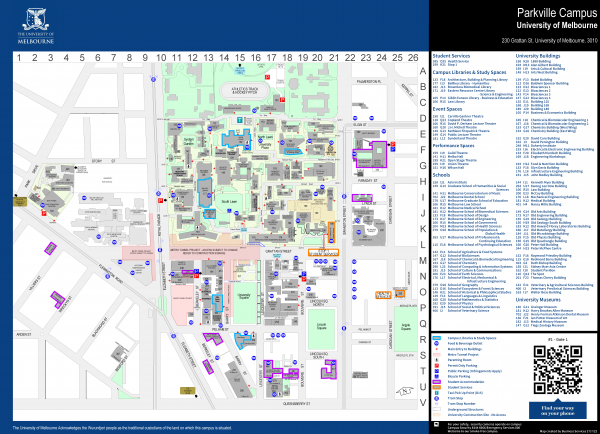
The University of Melbourne was founded in 1853 and is Australia’s second oldest university. The University spans two campuses with main campus located in Parkville and the second campus located in Southbank, where the Victorian College of the Arts resides.
You can view map of the Parkville Campus below, download a PDF copy, or access The University of Melbourne interactive map.
Navigating Melbourne
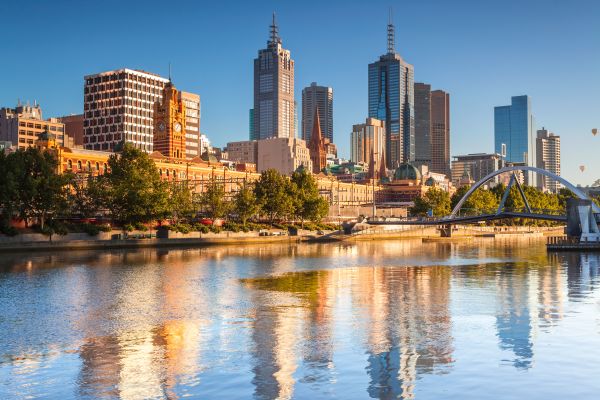
Melbourne, the capital of Victoria, is a beautiful city with fine buildings and spacious parks, which gives Melbourne its 'garden-city' title. Settlers from a variety of countries have given Melbourne a cosmopolitan outlook and the city has developed as the cultural, fashion, shopping, sporting and culinary centre of Australia.
Catching public transport:
Public transport commuters travelling on a full fare ticket are now able to use a credit card, phone or smartwatch across Melbourne.
Concession passengers will still need a myki card. You can purchase a myki card at most convenience stores or major train stations across Melbourne for $6.
There is a ‘Free Tram Zone’ within the Melbourne CBD, however outside of this area you will need to 'Touch On' your device, card or myki. You can download a map of the Free Tram Zone here. The free PTV app is also a useful resource to help with navigation by public transport.
Travelling from the airport:
The SkyBus travels from Tullamarine Airport to Southern Cross Station in the Melbourne CBD. The shuttle bus leaves the airport roughly every 20 minutes and costs $25.90 for a one-way pass or $43.40 for a return fare. Private shuttle buses from the airport can also be booked.
Places of interest include:
- Melbourne Zoo
- Melbourne Skydeck for the awe inspiring view of Melbourne from the Southern Hemisphere's highest viewing platform
- Fed Square, a venue for food, arts, culture and public events across from Flinders St Station, including the amazing Torres Strait owned and operated Indigenous restaurant, Mabu Mabu
- Many waterfront restaurants and cafes along the Yarra River or the District Docklands precinct
- The National Gallery of Victoria
- Royal Botanic Gardens, recognised as one of the world's best, extending over 38 hectares and housing a collection of more than 8,500 species of plants from around the world
- The Koorie Heritage Centre, exploring 60,000 years of culture of the Indigenous people of south-eastern Australia
For more information on Melbourne and its surrounding regions, please visit the following websites:
For queries contact:
Email: ALSM-Worshop@unimelb.edu.au